AI Conversational Sales Agents Are Becoming the New Standard in E-Commerce

5 min read
Article



AI Conversational Sales Agents Are Becoming the New Standard in E-Commerce
Only a short time ago, AI conversational sales agents felt like an experiment. A novelty. Something innovative brands tested in a limited pilot, while the rest of the market watched from a safe distance.
That phase is ending quickly.
Across e-commerce, a new interface is emerging: the AI conversational sales agent. Not a traditional chatbot that answers five FAQ questions. Not a basic live chat widget that depends on human availability. A true AI conversational sales agent that can talk to customers in natural language, understand their needs, compare products, recommend the right option, answer catalogue-specific questions and guide shoppers toward a purchase in real time.
In other words, online stores are starting to recreate something e-commerce has always missed: the experience of talking to a knowledgeable in-store sales associate.
From search box to conversation
For the last twenty years, the dominant e-commerce interface has been the same: search, filters, categories, product detail pages and reviews. That still works well when the customer knows exactly what they want.
But many customers do not.
They come to an online store with questions like:
“What is the best running shoe for knee pain?”
“Which laptop is good for video editing but not too expensive?”
“Which skincare routine should I choose for sensitive skin?”
“What is the difference between these two products?”
“Is this product suitable for a beginner?”
A traditional search box is not built for this. Filters help narrow options, but they do not explain. Product pages provide information, but they often force the customer to compare ten tabs manually. Human live chat can help, but it is expensive, hard to scale and usually limited by working hours.
AI conversational sales agents solve exactly this gap.
They turn product discovery from browsing into dialogue. The customer can describe their needs in their own words. The AI conversational sales agent can ask clarifying questions, compare suitable products, explain trade-offs and recommend a small number of relevant options.
This is not just customer support. It is guided selling.
The biggest retailers are already moving
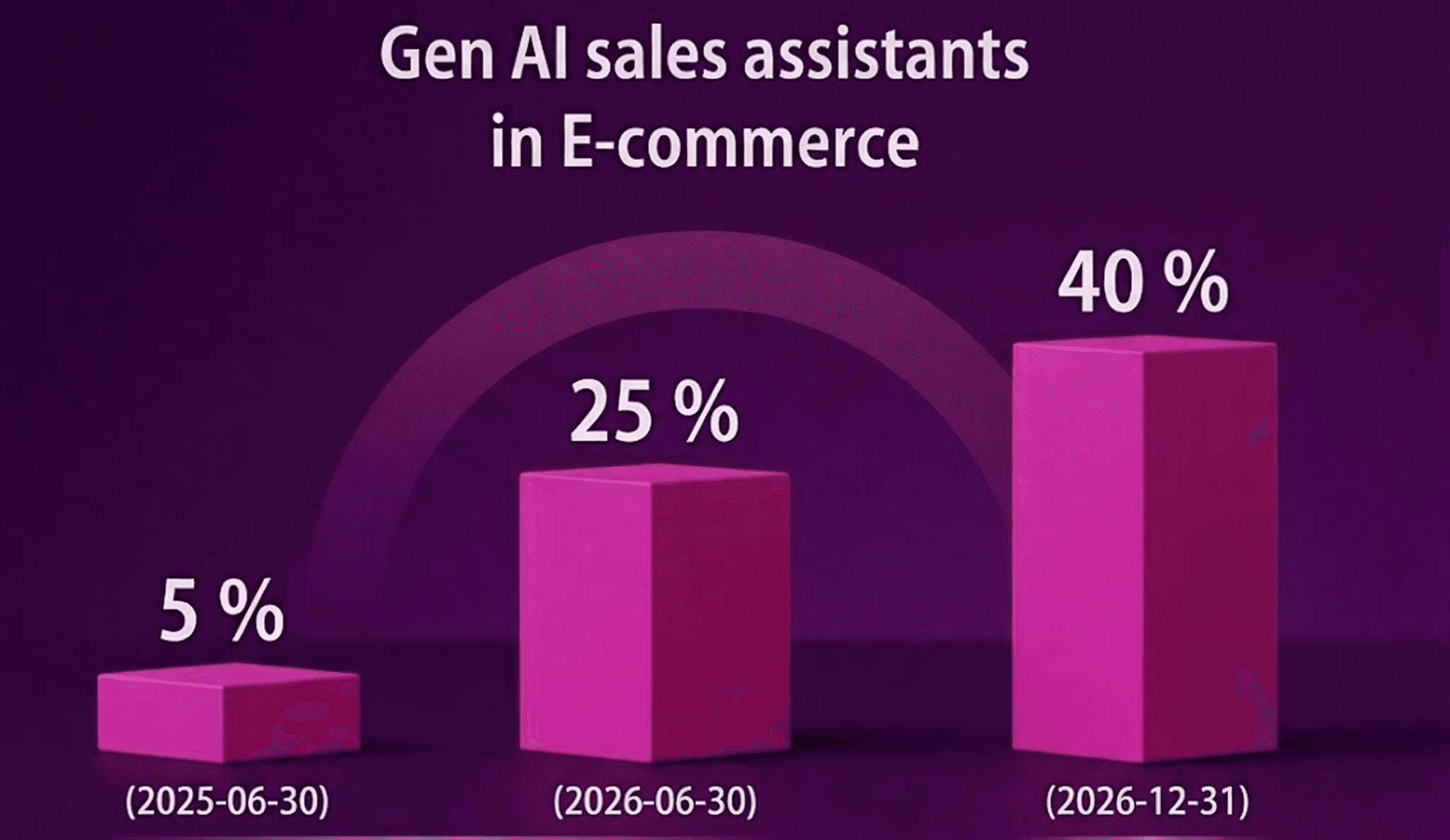
This shift is not theoretical. Some of the world’s largest retailers have already put AI-powered shopping assistants and AI conversational commerce experiences at the centre of their digital commerce strategy.
Amazon has rolled out Rufus and is now pushing AI deeper into the shopping journey through Alexa for Shopping. Walmart has launched Sparky, an AI shopping experience designed to help customers search, compare, plan and choose products. Sephora is bringing personalized beauty recommendations. Target has introduced AI-powered gift discovery. IKEA has experimented with an AI assistant that helps customers describe a room, explore the catalogue and receive tailored furnishing recommendations.
These are not small side projects. They are signs of where the market is heading.
When the largest players in retail start turning product discovery into conversation, it changes customer expectations for everyone else. Shoppers who experience instant, intelligent product guidance on Amazon, Walmart or Sephora will not forget that experience when they visit another online store.
They will start to expect it.
Why adoption is accelerating now
The reason is simple: customer behaviour is changing faster than e-commerce UX.
Modern shoppers are impatient. They do not want to wait for support teams. They do not want to search through hundreds of products. They do not want to read ten product descriptions to understand which option fits their needs.
They want answers now.
They want to compare options instantly. They want recommendations that reflect their actual situation. They want to ask follow-up questions. They want to make a confident purchase decision without leaving the page.
At the same time, GenAI has made AI conversational sales agents technically and commercially viable. An AI conversational sales agent can be connected to a product catalogue, knowledge base, brand rules and recommendation logic. It can operate 24/7, across peak traffic, across languages and across product categories.
That is why many e-commerce companies are no longer asking whether AI conversational sales agents will matter. They are asking how quickly they can test and deploy them.
The FOMO moment for mid-sized and large e-commerce brands
The most important point is this: the advantage will not only come from having an AI conversational sales agent. It will come from having it early enough to learn.
The first version of an AI conversational sales agent is only the beginning. The real value comes from customer conversations: what people ask, where they hesitate, what comparisons they need, which products they click, which answers convert and where the catalogue data is weak.
Every conversation becomes a source of commercial insight.
Stores that deploy early start building this learning loop now. They learn which product attributes matter. They discover gaps in product descriptions. They understand how customers describe needs in natural language. They improve recommendations, refine category logic and optimise the customer journey.
Stores that wait will not only be late with the technology. They will be late with the learning.
That is the real risk.
In e-commerce, customer acquisition is expensive, margins are under pressure and attention spans are short. If two stores sell similar products, but one can instantly guide the customer to the right choice while the other still leaves them alone with filters and product pages, the difference becomes obvious.
The assisted store feels easier.
The assisted store feels more confident.
The assisted store reduces purchase friction.
The assisted store is more likely to convert undecided shoppers.
AI conversational sales agents are not replacing websites. They are changing how customers use them.
The goal is not to replace product pages, search or filters. The goal is to add a new layer on top of them: a conversational layer that helps customers navigate complexity.
In many categories, this is especially powerful: fashion, beauty, electronics, sports equipment, furniture, DIY, pet products, supplements, tools, baby products and any other segment where customers need advice before buying.
The more complex the decision, the more valuable the AI conversational sales agent becomes.
A customer buying a simple commodity may not need a conversation. But a customer choosing the right tennis racket, skincare routine, sofa, laptop, running shoe, drill, stroller or gift very often does.
That is where AI conversational sales agents become a competitive advantage.
The new benchmark for e-commerce experience
A few years ago, fast delivery became a standard. Then easy returns became a standard. Then personalised recommendations became a standard. Now conversational product guidance is becoming the next layer of customer experience.
The question for e-commerce leaders is no longer whether AI conversational sales agents are coming.
They are already here.
The real question is: when customers start expecting instant, intelligent product advice everywhere, will your store be ready — or will they get that experience from your competitors first?


Alex Karo
CEO of ROBOSALES.AI